


 9 / 25

A N N U A L A C T I V I T I E S R E P O R T 2 0 1 5 | 9
The Chiang Rai Village Project is our flagship project and
its aim is to increase the enrollment rate and access to
quality education of hill-tribe minorities while assisting
communities and villages to become self-sustainable
through agriculture programs. According to UNICEF, the
challenges faced by Hill-Tribe children include access
to education, trafficking, child labor, poverty, stunting,
malnutrition, and exposure to drug and alcohol use.
Although the government is responsible for the provision
of education to all Thai people, educational provision is
not always effective and hill tribe students are subject
to high levels of school withdrawal and poor academic
performance.
The quality of education is a major issue of concern
nationwide, and the level is further compromised in rural
areas and in the less privileged northeast regions, where
a shortage of qualified teachers is common. Enrollment in
school for hill-tribe children who lack citizenship represents
the beginning of a formal process to becoming a Thai
citizen: with a student card they are able to travel and
initiate the application process for citizenship. Hill tribe
families often lack the financial resources to provide for
their children’s secondary school education.
The Project supports ethnic minority children’s education
from impoverished hill-tribe villages from Kindergarten to
Professional School, while promoting the village’s sustain-
able development by improving access to health and
sanitation and promoting income generating activities
of families through agriculture. The aim is for families to
be able to support their own children’s education in the
medium term.
The Foundation currently supports the education of over
1,400 hill-tribe children and we have completed over
30 school infrastructure projects, including primary and
secondary schools, kindergartens and preschools, teacher
accommodations, dormitories, libraries, computer rooms,
sanitation facilities, kitchens, canteens, sports fields, and
playgrounds. We have also provided 3 clean water systems
and 1 health post.
Once we build a school, we maintain close relationship
with school staff, beneficiaries and the village community
to monitor the level of education of the school, oversee
beneficiaries’ academic progress, and identify problem
areas that need to be addressed. Our staff meets regularly
during the year with all stakeholders and keeps track of key
performance indicators such as Teacher absentee rate,
Student pass rate, Retention rate, and Student Teacher Ratio.
In some villages we have built dormitories to allow students
from very small neighboring villages to access the school,
when daily commuting is not possible. When possible, we
provide daily transportation to school to students. At the
same time, we work with village representatives and the
community to identify the village urgent needs including
access to water and health care. This is fundamental to
our bottom up approach. Villagers are involved also in
construction projects, helping for example in manual work,
and in maintenance of buildings and projects. We work the
families most in need to implement agricultural projects
and with schools to set up School Gardens.
Since the launch of our project in 2006, we are heart-
ened to witness the incredible progress of the villages
we support. There is now 100% enrollment in these
villages, 284 students from these villages have completed
Professional School, and all the villages have access to
clean water and sanitation facilities in school. The level
of nutrition has dramatically improved thanks to the
village school canteen and the incidence of common
ailments and diseases has significantly decreased. Over
90% of families are now above the poverty line and
we are slowly reducing our support and focusing more
on improving the quality of education in schools and
increasing sustainable community agricultural activi-
ties. The standard of living in all the villages we support
has substantially improved. Our aim is to replicate and
scale the village project to more villages in need.
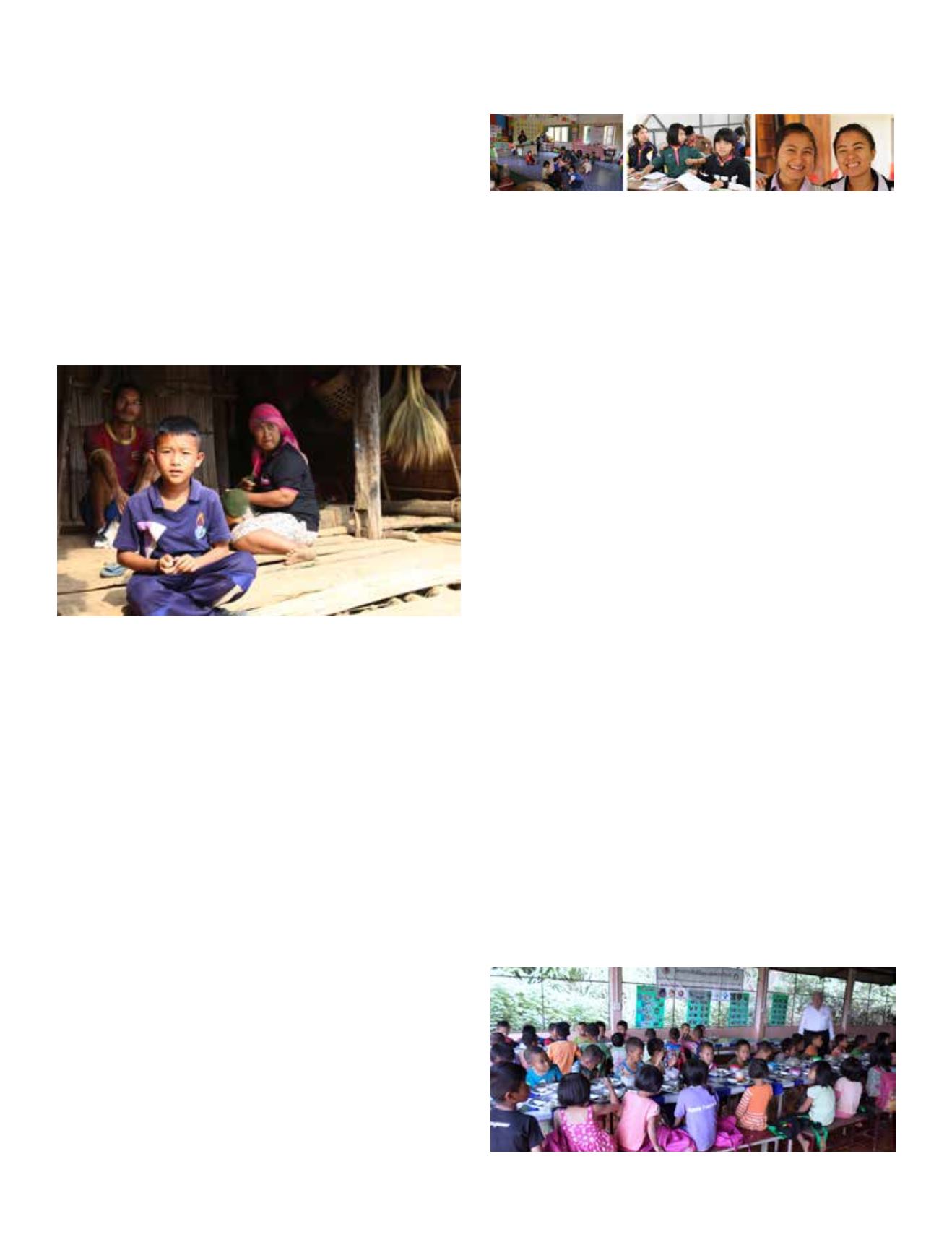
Pasquale Pistorio in Huay Kuk Village Primary School Canteen, Thailand
Hill Tribe Village home
Our long-term scholarship program follows progress of beneficiaries
from Kindergarten to Professional School